
Project Portfolio
Health Economics Model & App
Sample Case Study: Evidence-based model for estimating the health and economic impacts of a social care initiative in the UK
The Objective
An evidence-based simulation forecast was commissioned as part of an independent evaluation of a government-funded social care initiative. The goal was to demonstrate the program’s viability by modeling its potential economic and health impacts.
The Deliverables
A dynamic, scenario-based ‘Social ROI’ model was developed using data from academic research and other reputable sources and was delivered as an interactive web app. Additional assets included a simplified Excel model version, full documentation of sources and methods, and illustrated diagrams detailing the model’s core calculations, with embedded source links.
Health Economics Model Case Study Details
Problem Description
An innovative UK social care system requires an evidence-based impact model
Social care involves providing support for individuals who need assistance with daily activities, such as personal care or household tasks. With an aging population, the demand for social care has surged in the UK, straining the system dramatically, and because of this, many individuals face delayed or inadequate care, while local authorities struggle to meet the increasing demand.
To address these issues, the UK government funded a selection of five trailblazer programs aiming to test innovative solutions to the social care challenge. Each program was required to conduct an independent social and economic learning and impact evaluation. The social and economic impact forecast model described here was commissioned as part of one such evaluation.
Research
Scant evidence connecting interventions to specific outcomes of interest
The challenge of the research phase was finding strong evidence linking social care initiatives with specific health and economic outcomes (e.g., reduction in delayed hospital discharges) because either the research has not been done, or the focus was not applicable.
Ultimately, the model pulled from all available, relevant academic research, hospital and provider data from the NHS, and where needed, educated assumptions based on grey literature were employed.
Development & Delivery of Forecast Model
The model was built into both an online app & an Excel workbook
The forecast model was built in a modular fashion so that the various economic and health-related impacts could each be examined separately. To fulfill the client’s needs, the forecast model was built first as an Excel workbook, as it was easy to share and discuss internally during development. The model was also coded in R and deployed as an online Shiny app. This online version had greater functionality compared to the Excel version and could act as a kind of ‘sandbox’ for comparing impacts across various program scenarios.
Full documentation of the impact model calculations and input data – including diagrams describing each module – accompanied the models.
Health Economics Model Case Study Images

Portfolio Highlight - Social Care Impact Model

Portfolio Highlight - Social Care Impact Model - Shiny App Contents Overview

Portfolio Highlight - Social Care Impact Model - Deliverable Detail
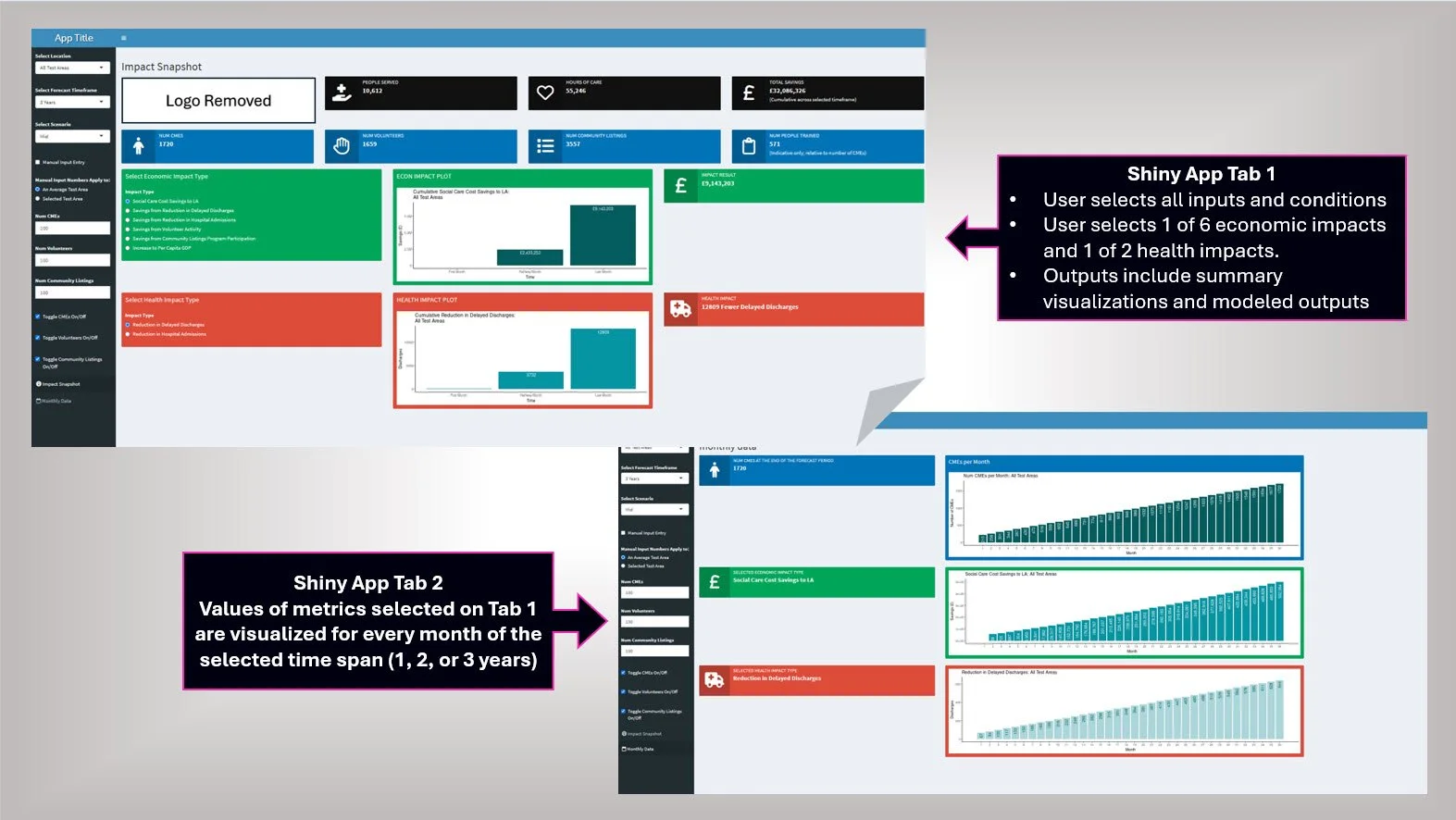
Portfolio Highlight - Social Care Impact Model - Shiny App Screenshots with Dummy Input Data
More Examples of Healthcare-Related Projects
DNP Project Consulting & Statistics Help (Multiple)
Healthcare / Cost Analysis
Provided statistical consulting support to multiple Doctor of Nursing Practice (DNP) candidates for their capstone projects. Each engagement included statistical analysis, a comprehensive written report detailing methodology, results, interpretation, and visualizations, plus coaching and tutoring to help candidates prepare for their oral defense before academic committees.
Lung Cancer Second-Line Treatment Decision Model
Biotech / Pharma / Oncology
Devised a pilot treatment decision model for non-small cell lung cancer patients requiring second-line treatment. The decision model combined survival probabilities and incremental cost data for each potential treatment pathway (including clinical trial therapies) and resulted in a shortlist of recommended treatment pathways, ordered by cost per QALY gained.
Claims-Based Treatment Cost Modeling & Analysis
Healthcare Cost Analysis
Investigated multiple years of hospital, physician, and pharmaceutical insurance claims data to quantify lifetime costs for patients with a rare genetic condition. The project involved navigating the scale and complexity of U.S. health claims datasets and resolving challenges in longitudinal record matching across time and geographic relocation.
Multi-Scenario Financial Forecast for Biotech Company
Biotech / Pharma
Refactored, refined, and expanded a multi-scenario, 20-year financial forecasting model for a burgeoning biotech company developing RNA-based vaccines and therapies. The financial forecast model was based on an array of pertinent factors including, but not limited to, differing scenario-based probabilities of success across successive clinical trial stages for therapeutic candidates in nine functional pipelines and time-dependent batch cost amounts calculated using decay functions unique to each asset.
Healthcare Use Cases for Deep Learning: Research & Content
Healthcare / AI / Computer Vision
Conducted academic research on applications of deep learning models (such as convolutional neural networks) in healthcare and medicine. Distilled findings into a white paper and a set of visually engaging presentation slides. The project supported the marketing efforts of a supercomputer manufacturer by strengthening the case for using their systems to power deep learning models aimed at improving health and medical outcomes.
Cumulative Risk Model for Drug Combinations in Epilepsy Care
Pharma / Medical Research
Developed a cumulative risk model to estimate the likelihood of adverse effects in epilepsy patients undergoing multiple concurrent therapies. Synthesized findings from published studies reporting individual drug risks and built a statistical framework to quantify overlapping risk. The project addressed challenges in harmonizing heterogeneous data sources and translating clinical literature into a usable, novel model for decision support.